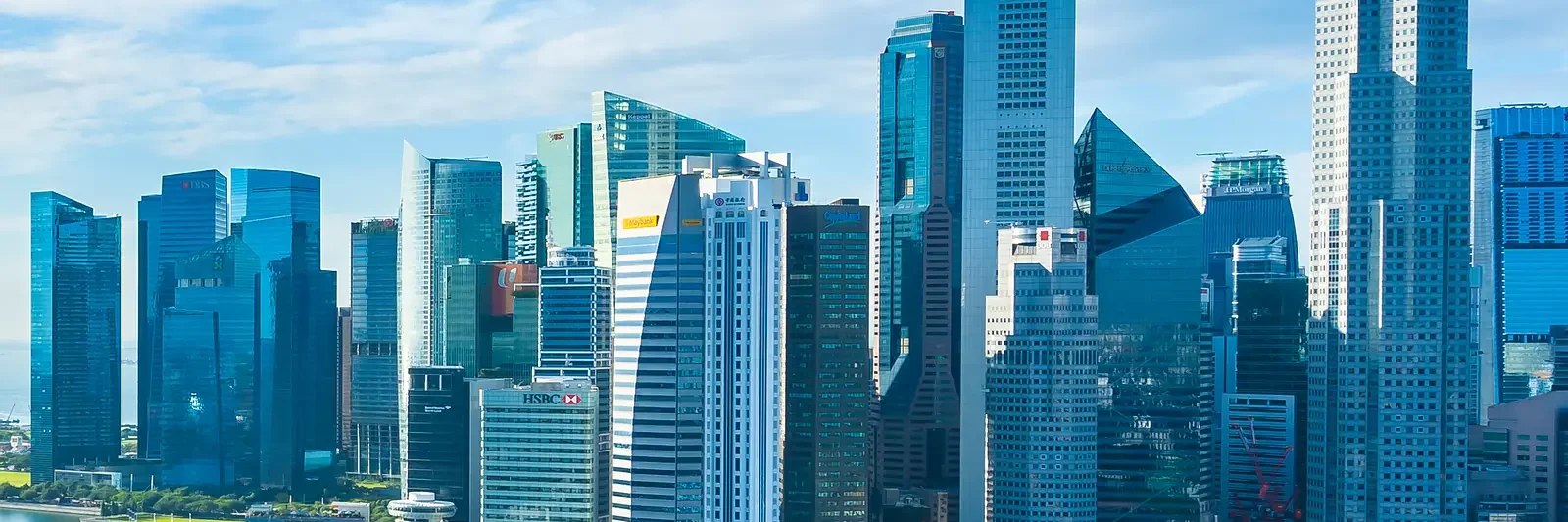
Raffles Place and Marina Bay
Raffles Place and Marina Bay, with Tanjong Pagar, make up the core of Singapore’s central business district. One grew from land reclaimed in the 1820s, the other from a plan drawn up in 1991. If you are looking for a base for a regional headquarters, a treasury or a family office, this is the district to start with.
From Commercial Square to the new downtown
In 1823 a hill near the river was levelled and its earth used to reclaim marshy land on the south bank. The result was Commercial Square, later renamed Raffles Place, which remained the financial district of Singapore into the twenty-first century. It lies within the Downtown Core defined by the Urban Redevelopment Authority.
Marina Bay came much later. The 1991 Concept Plan mapped it as a new downtown and an extension of the central business district, and the first land sale followed in 2001. Around 2013 the authority described Marina Bay Financial Centre as a choice location for financial institutions.
The financial centre in figures
These figures cover Singapore as a whole. The directory of the Monetary Authority of Singapore, read on 4 November 2026, lists 6 local bank, 10 qualifying full bank, 20 full bank, 96 wholesale bank and 21 merchant bank licences, together with 27 representative offices. One bank may hold several licences, so the numbers should not be added up.
Assets under management stood at S$6.7 trillion on 31 December 2025, of which 76 per cent was sourced from outside Singapore and 88 per cent was invested outside it. At that date 1,320 fund management companies were licensed. The BIS survey of April 2025 places Singapore third among foreign exchange markets, after the United Kingdom and the United States, with US$1.485 trillion a day. SGX reported a market capitalisation of S$1,120.3 billion at the end of April 2026. The Global Financial Centres Index published on 16 September 2026 ranks Singapore 4th of 117 centres, behind New York, London and Hong Kong.
Practical points
A Singapore company needs a registered office in Singapore from the day of incorporation, at least one share with a capital of at least S$1 and at least one director who is ordinarily resident. Corporate income tax is a flat 17 per cent for local and foreign companies alike, and GST has been 9 per cent since 1 January 2024. Staff from abroad need a work pass. For new Employment Pass applications in financial services the qualifying salary runs from S$6,200 to S$11,800 a month until the end of 2026, and from S$6,600 to S$12,700 for applications from 1 January 2027.
The articles below come from the books Singapore as an International Financial Centre and Digital Assets Law in Singapore and Switzerland. They cover regulation, banking, tax and disputes.
Across the Singapore financial centre
Singapore · Book
Singapore as an International Financial Centre — preface
Singapore · Origins
A Place on the Strait: Temasek, Singapura and the Maritime Trade of the Malay World
Singapore · Origins
The Strait of Malacca as a corridor of trade
Singapore · Origins
Temasek and Singapura in the fourteenth century: archaeology and chronicle
Singapore · Origins
Malacca, Johor and the Riau archipelago
Singapore · Origins
Portuguese, Dutch and British rivalry in the Straits
Singapore · Origins
What the pre-colonial port teaches about location and trust
Singapore · Origins
A Place on the Strait: Temasek, Singapura and the Maritime Trade of the Malay World: summary
Singapore · Origins
Raffles, the East India Company and the Free Port of 1819
Singapore · Origins
The East India Company and the China trade
Singapore · Origins
Stamford Raffles and William Farquhar
Singapore · Origins
The agreements with Sultan Hussein and the Temenggong
Singapore · Origins
The free-port principle: open to every flag
Singapore · Origins
Early growth and the first merchant community
Singapore · Origins
What 1819 means for the financial centre
Singapore · Origins
Raffles, the East India Company and the Free Port of 1819: summary
Singapore · Origins
The Treaties of 1824 and the Legal Foundations of British Singapore
Singapore · Origins
The Anglo-Dutch Treaty of 1824
Singapore · Origins
The Treaty of Friendship and Alliance of 1824
Singapore · Origins
The Straits Settlements and the Second Charter of Justice
Singapore · Origins
The reception of English law
Singapore · Origins
Land, title and the security of property
Singapore · Origins
Practical consequences for today’s practitioner
Singapore · Origins