Doing Business in Singapore
Singapore combines a common law legal system, a flat corporate tax rate of 17 per cent, no tax on gains of a capital nature and a port and financial market that serve the whole of Asia. This page sets out what a company, an investor or a family needs to know before doing business here, step by step, and leads to the articles on each subject. It states the law as at 4 November 2026 unless a passage gives another date.
Why Singapore
Singapore law grew from English law, which came to the Straits Settlements with the Second Charter of Justice of 27 November 1826. Contracts, company documents and court filings are in English, and a lawyer trained in another common law system recognises the concepts at once. The background is told in The reception of English law and Common law, equity and the reception of English law. Openness to every flag was the founding principle of the port of 1819 (The free-port principle).
The figures show the scale. Nominal GDP reached S$789.5 billion in 2025, with real growth of 5.0 per cent, and the population stood at 6.21 million in June 2026. Assets under management came to S$6.7 trillion at the end of 2025, and 76 per cent of them were sourced outside Singapore. In the BIS survey of April 2025 Singapore was the third-largest foreign exchange centre after the United Kingdom and the United States. The Global Financial Centres Index published on 16 September 2026 places it 4th of 117 centres, behind New York, London and Hong Kong. The port handled a record 44.66 million TEU in 2025.
Singapore has 29 implemented free trade agreements (Ministry of Energy, Trade and Industry, August 2026), among them RCEP, the CPTPP and agreements with China, India, the EU, the EFTA states and the United Kingdom. IRAS describes its network of double taxation and related agreements as covering around 100 jurisdictions, a figure that includes limited agreements and exchange-of-information arrangements. With Hong Kong and the United States there is only a limited agreement on ships and aircraft, so no comprehensive treaty relief is available on those routes.
Setting up your company
The usual vehicle is the private company limited by shares under the Companies Act 1967, registered with the Accounting and Corporate Regulatory Authority (ACRA). It can be formed with one shareholder, one director and a share capital of S$1. The company needs a registered office in Singapore from incorporation and a register of registrable controllers from the day of incorporation, with updates within seven days. An auditor must be appointed within three months of incorporation unless the company is exempt.
A company secretary must be a natural person whose principal or only residence is in Singapore, appointed within six months of registration. A sole director cannot also be the secretary (section 171). Anyone providing corporate services as a business must be registered with ACRA under the Corporate Service Providers Act 2024, in force since 9 June 2025. Other forms, among them the company limited by guarantee, the limited liability partnership and the registered foreign company, are compared in The candidates and the register, The private company limited by shares and Choosing among them. Advice on which form fits your plan is a matter of Singapore law, and Dr Ressos can arrange it for you.
The resident director
Section 145 of the Companies Act 1967 requires at least one director who is ordinarily resident in Singapore. Directors must be at least 18, and a sole director may also be the sole member. In the terms used in the Digital Assets book, ordinarily resident covers a citizen, a permanent resident and the holder of an Employment Pass, EntrePass or ONE Pass with a local residential address, and a foreigner on a short-term visit pass does not qualify. A founder who will not move has to find a resident director. Under the Corporate Service Providers Act 2024 nominee directors may be supplied by way of business only through a registered provider, which must check that the nominee is fit and proper. The question how to fill this post in your case goes to Dr Ressos.
Banking and onboarding
The MAS directory read on 4 November 2026 lists licences for 6 local banks, 10 qualifying full banks, 20 full banks, 96 wholesale banks and 21 merchant banks, as well as 27 representative offices. These are counts of licences, and one bank may hold several. A bank must identify the beneficial owners of a new client, understand the purpose of the relationship and apply enhanced measures where the risk calls for them.
The money-laundering case of August 2023, with seized assets of more than S$3 billion, sharpened those questions for private banks, corporate service providers and family offices alike (Why one case has its own chapter). Digital-asset businesses meet the most careful reception. Read Opening an account in Singapore, What a bank wants to see over time and Bankability and Onboarding. A clear structure chart and documented sources of funds will save you repeated questions from the bank. Singapore-law questions on the account relationship go to Dr Ressos.
Work passes
The Employment Pass requires a qualifying salary and, as a second stage, 40 points under COMPASS. Until the end of 2026 the qualifying salary runs from S$5,600 to S$10,700 by age, and from S$6,200 to S$11,800 in financial services. For new applications from 1 January 2027 it rises to S$6,000 to S$11,500, and to S$6,600 to S$12,700 in financial services, and renewals expiring from 1 January 2028 take the new scale (Ministry of Manpower, page of 3 November 2026). From 1 January 2027 the S Pass requires S$3,600, or S$4,000 in financial services.
The EntrePass has no minimum salary. It requires a private limited company in which the holder has at least 30 per cent, which is venture-backed or based on innovative technology and meets a further criterion such as a funding round of S$100,000. The ONE Pass requires a fixed monthly salary of S$30,000 for 12 months or outstanding achievements. Tech.Pass gives way on 28 January 2027 to a ONE Pass (AI and Tech). The Global Investor Programme offers permanent residence routes through a S$10 million business investment, a S$25 million investment in an approved fund or a single family office with S$200 million under management. See The pass system, Relocation to Singapore and Residence and Relocation. Dr Ressos can arrange Singapore-law advice on a pass application.
Tax
Corporate income tax is a flat 17 per cent for local and foreign companies. New companies may claim the start-up exemption for their first three years of assessment: 75 per cent on the first S$100,000 and 50 per cent on the next S$100,000, with investment holding and property development companies excluded. Others have the partial exemption: 75 per cent on the first S$10,000 and 50 per cent on the next S$190,000. For the year of assessment 2026 there is a rebate of 50 per cent with a S$2,000 cash grant, capped at S$40,000 together.
Singapore does not tax gains of a capital nature. Trading gains remain taxable, and section 10L of the Income Tax Act 1947 taxes foreign-asset disposal gains received in Singapore where the entity lacks economic substance or the asset is foreign intellectual property. Section 13W offers a safe harbour for a holding of 20 per cent kept for 24 months. Dividends from a Singapore resident company are exempt in the recipient's hands, and there is no withholding tax on them. Interest bears 15 per cent and royalties 10 per cent, subject to treaty relief. Foreign dividends, branch profits and service income may be exempt under section 13(8) if its conditions are met. GST stands at 9 per cent since 1 January 2024. Groups with revenue of EUR 750 million or more pay a top-up to 15 per cent for financial years from 1 January 2025.
Resident individuals pay progressive rates up to 24 per cent above S$1 million. Non-resident employees pay the higher of a flat 15 per cent or the resident rates, and director's fees of non-residents bear 24 per cent. Estate duty was removed for deaths on and after 15 February 2008. Read The charge to tax and its territorial logic, The absence of a charge and its three qualifications and Section 10L. Singapore tax questions in a particular case go to Dr Ressos.
Family offices and trusts
More than 2,000 single family offices held fund tax incentives under sections 13O or 13U at the end of 2025. MAS counts only recipients, so the total number of family offices is unknown. For new awards from 1 August 2026 (MAS circular of 31 July 2026), section 13O and 13OA funds need S$20 million in designated investments and two qualifying investment professionals, one of them from outside the family. Section 13U funds need S$50 million and three professionals. Local business spending starts at S$200,000 a year and rises with assets, and the fund must deploy the lower of 10 per cent of its assets or S$10 million in the qualifying options. A class exemption has freed single family offices from licensing since 15 June 2026, without approval but with a notice to MAS within 14 days, and existing offices have until 15 June 2027.
The book chapters state the law at 30 June 2026 and explain the model: The Singapore family office model and The tax incentive conditions. Singapore-law trusts rest on the Trustees Act, and a licence under the Trust Companies Act 2005 is needed for trust business, with exemptions for banks and private trust companies (The Trust Companies Act 2005). A family's questions under Singapore law go to Dr Ressos, who also coordinates the Swiss, English, Hong Kong or German side.
Funds and the VCC
The Variable Capital Companies Act 2018, in force since 14 January 2020, created a corporate fund vehicle that can stand alone or serve as an umbrella with sub-funds. At the end of 2025 there were 1,406 VCCs with 3,443 sub-funds, and 1,320 licensed fund management companies. A manager needs a capital markets services licence for fund management under the Securities and Futures Act 2001, as a retail or as an accredited and institutional manager. The former registered manager regime has been repealed. For funds other than single family office funds, MAS removed the annual minimum for assets retroactively from 1 January 2025. See The Variable Capital Company, The three schemes and Singapore Variable Capital Company. Dr Ressos can arrange advice on fund structuring under Singapore law.
Disputes
Arbitration is governed by the International Arbitration Act 1994, which gives effect to the UNCITRAL Model Law and the New York Convention. The seventh edition of the SIAC Rules applies to arbitrations commenced from 1 January 2025. The Singapore International Commercial Court, established in 2015 as a division of the General Division of the High Court, hears international commercial disputes. The Rules of Court 2021 have applied since 1 April 2022, and the main provisions of the Insolvency, Restructuring and Dissolution Act 2018 since 30 July 2020.
The Singapore Convention on Mediation entered into force on 12 September 2020, and the Hague Choice of Court Convention on 1 October 2016 for Singapore. Since 1 March 2023 foreign judgments from Commonwealth states fall under the Reciprocal Enforcement of Foreign Judgments Act 1959. A judgment from a state that has not been gazetted, such as Switzerland, has to be enforced by an action at common law. Read The forum choice, The legal framework, Recognition and enforcement of judgments and Litigation and Arbitration. A dispute before a Singapore court or under Singapore law goes to Dr Ressos.
Compliance and digital assets
Three statutes carry the regime against money laundering and terrorist financing: the Corruption, Drug Trafficking and Other Serious Crimes (Confiscation of Benefits) Act 1992, the Terrorism (Suppression of Financing) Act 2002 and the sectoral Acts under which MAS issues binding notices. Singapore implements United Nations sanctions, and in March 2022 it added its own measures against Russia. See Three statutes and one regulator and Singapore's approach to sanctions.
Digital payment token services need a licence under the Payment Services Act 2019. Since 30 June 2025 Part 9 of the Financial Services and Markets Act 2022 has required a licence from providers serving only overseas customers, with no transition period. The stablecoin framework was not yet law on 4 November 2026: draft amendments were consulted on until 16 October 2026, and subsidiary legislation is to follow. The full account is in Digital Assets Law in Singapore and Switzerland. Whether your business needs a licence is a Singapore-law question that Dr Ressos can take up with you.
Capital markets
SGX had 604 listings on 30 September 2026, 406 on the Mainboard and 198 on Catalist, with a market capitalisation reported at S$1,184.8 billion. An offer of securities generally needs a prospectus registered with MAS unless an exemption applies (Prospectus requirements and exemptions). Questions on an offer or a listing under Singapore law go to Dr Ressos.
Where business happens
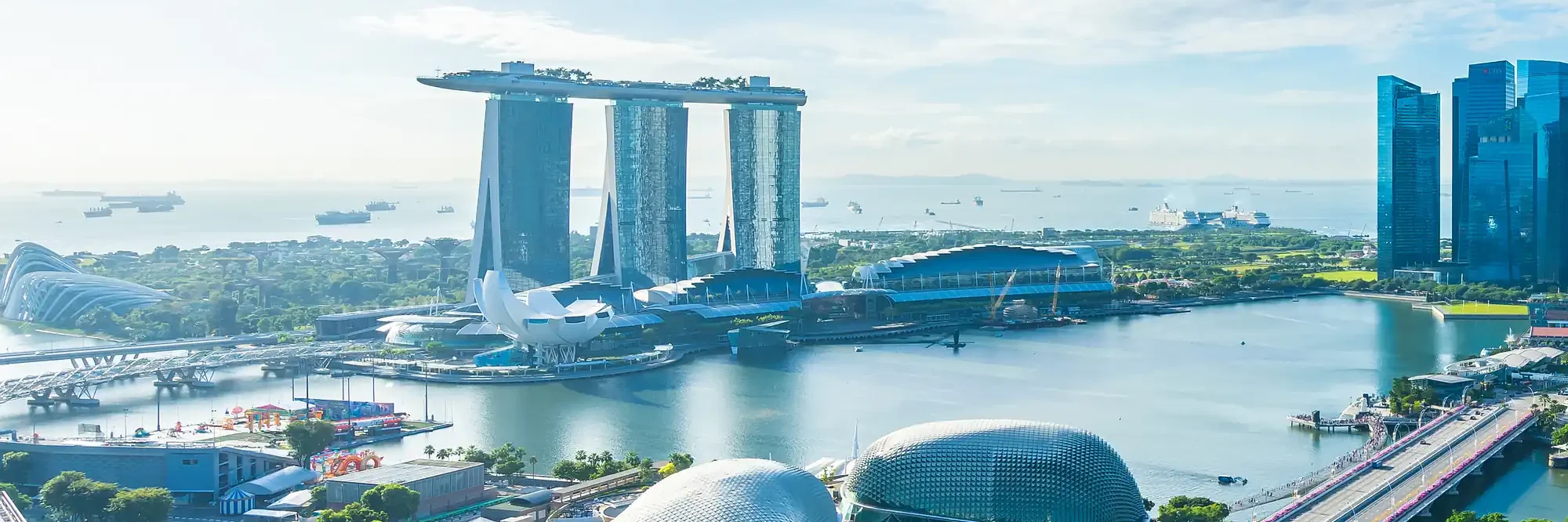
The financial sector sits around Raffles Place and Marina Bay. Industry and the new port lie in Jurong and Tuas, research and technology companies in one-north. Beyond the border, see the Johor-Singapore SEZ and Batam, Bintan and Karimun.
Who publishes this page
SingaporeIQ is published by Dr Alexander Ressos. Dr Ressos is Of Counsel with KGP Legal LLC. All Singapore law advice is provided through KGP Legal LLC, a duly licensed firm of Singapore advocates and solicitors (licence LSRA/LLC/2017/00023), 10 Anson Road #03-27 International Plaza, Singapore 079903. All enquiries should be directed to Dr Alexander Ressos at [email protected].
SingaporeIQ is an information website. It gives no legal advice, and reading it creates no client relationship. Dr Ressos can coordinate the international side of a matter and advise on Swiss, English, Hong Kong and German law. Both routes are on the contact page.
Banking, Wealth Management and Family Offices
Singapore · Origins
Clan, Kongsi and Credit: The Moral Economy of Chinese Commerce
Singapore · Origins
Confucian ethics and commerce: a debate revisited
Singapore · Origins
Dialect groups, clan associations and huiguan
Singapore · Origins
Kongsi and secret societies: governance beyond the colonial state
Singapore · Origins
Xinyong: reputation as collateral
Singapore · Origins
Remittance houses and the qiaopi networks
Singapore · Origins
The Straits Chinese: a bridge between two legal worlds
Singapore · Origins
From personal trust to institutional trust
Singapore · Origins
The moral economy of the Strait and the comparison with Geneva
Regulation and Supervision
Singapore · Origins
The Treaties of 1824 and the Legal Foundations of British Singapore
Singapore · Origins
The Anglo-Dutch Treaty of 1824
Singapore · Origins
The Treaty of Friendship and Alliance of 1824
Singapore · Origins
The Straits Settlements and the Second Charter of Justice
Singapore · Origins
The reception of English law
Singapore · Origins
Land, title and the security of property
Singapore · Origins
Practical consequences for today’s practitioner
Singapore · Origins
Legal foundations and the comparison with Geneva
Singapore · Origins
The Treaties of 1824 and the Legal Foundations of British Singapore: summary
Digital Assets
Singapore · Crypto
Singapore Legal Opinions on Crypto Projects
Singapore · Singapore 2035
Crypto-assets: From the Payment Services Act to Project Guardian
Singapore · Singapore 2035
The Payment Services Act 2019
Singapore · Singapore 2035
Collapses of 2022 and their regulatory consequences
Singapore · Singapore 2035
Digital token service providers under the FSMA
Singapore · Singapore 2035
Stablecoins
Singapore · Singapore 2035
Project Guardian and tokenisation
Singapore · Singapore 2035
Crypto-assets: From the Payment Services Act to Project Guardian: practical consequences
Singapore · Singapore 2035
The comparison with Geneva and Zurich
AML, Sanctions and Compliance
Singapore · Wealth Management
Integrity Shocks: 1MDB and the 2023 Money Laundering Case
Singapore · Wealth Management
1MDB and the Singapore banks
Singapore · Wealth Management
Supervisory action by the Monetary Authority of Singapore
Singapore · Wealth Management
The 2023 money laundering case
Singapore · Wealth Management
Lessons for onboarding and source-of-wealth checks
Singapore · Wealth Management
Reputation as a regulatory objective
Singapore · Wealth Management
Integrity Shocks: 1MDB and the 2023 Money Laundering Case: Comparison with Geneva
Singapore · Wealth Management
Integrity Shocks: 1MDB and the 2023 Money Laundering Case: summary
Singapore · Trade Finance and Risk
Anti-Money Laundering: The CDSA, MAS Notices and the FATF Evaluations
Tax and Transparency
Singapore · Wealth Management
The End of Banking Secrecy for Foreign Tax Purposes
Singapore · Wealth Management
The OECD standard of 2009 and Singapore's commitment
Singapore · Wealth Management
FATCA and the intergovernmental agreement
Singapore · Wealth Management
The Common Reporting Standard
Singapore · Wealth Management
Tax crimes as predicate offences for money laundering
Singapore · Wealth Management
Legacy assets and the regularisation of clients
Singapore · Wealth Management
The End of Banking Secrecy for Foreign Tax Purposes: practical consequences
Singapore · Wealth Management
The End of Banking Secrecy for Foreign Tax Purposes: Comparison with Geneva
Singapore · Wealth Management
The End of Banking Secrecy for Foreign Tax Purposes: summary
Courts, Arbitration and Mediation
Singapore · Colonial Economy
Crown Colony: Government, Courts and Commercial Law after 1867
Singapore · Colonial Economy
The transfer to the Colonial Office in 1867
Singapore · Colonial Economy
The Legislative Council and the ordinances
Singapore · Colonial Economy
Courts, the Privy Council and the legal profession
Singapore · Colonial Economy
Company law, insolvency and currency
Singapore · Colonial Economy
Revenue without customs: the fiscal constitution of the free port
Singapore · Colonial Economy
The colonial codes in today’s financial crime practice
Singapore · Colonial Economy
Law as a commercial asset
Singapore · Colonial Economy
Crown Colony: Government, Courts and Commercial Law after 1867: summary
Financial History
Singapore · Origins
A Place on the Strait: Temasek, Singapura and the Maritime Trade of the Malay World
Singapore · Origins
The Strait of Malacca as a corridor of trade
Singapore · Origins
Temasek and Singapura in the fourteenth century: archaeology and chronicle
Singapore · Origins
Malacca, Johor and the Riau archipelago
Singapore · Origins
Portuguese, Dutch and British rivalry in the Straits
Singapore · Origins
What the pre-colonial port teaches about location and trust
Singapore · Origins
A Place on the Strait: Temasek, Singapura and the Maritime Trade of the Malay World: summary
Singapore · Origins
Raffles, the East India Company and the Free Port of 1819
Singapore · Origins